The Dawn of Capability
1. The Arrival
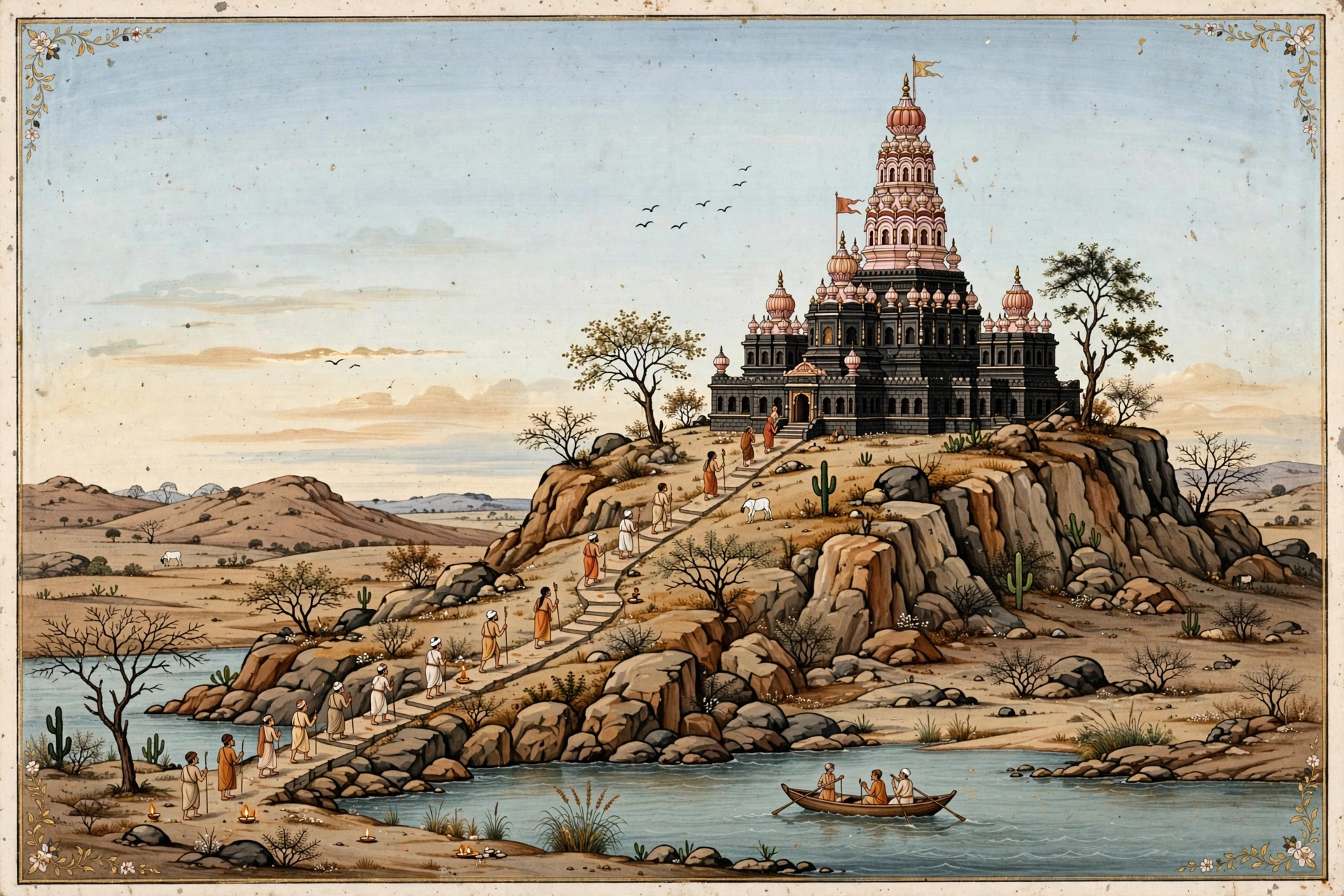
Siddhatek does not coddle you. It rises abruptly from the banks of the Bhima River, a rocky hillock under a vast, unforgiving sky. The climb is gentle but deliberate, each step a small act of preparation. The temple, built of stone that matches the hill it rests upon, offers no ornamentation, no distraction. Just the rhythm of your own breath and the distant murmur of the river below. This is not a place of comfort. This is a place of readiness.
As you walk the path, the dry, resilient landscape of the Ahmednagar district surrounds you. The wind carries the scent of sun-baked earth and the faint whisper of flowing water. The vast sky seems closer here, as if to remind you that capability is not built in comfort. You are not here to rest. You are here to become capable.
Unlike the fortress of Moregaon, there are no walls here. The temple sits exposed, anchored into the rock itself. It has nothing to hide, because what it teaches cannot be stolen. It can only be earned. With each step upward, the noise of “I can’t” falls away. What remains is the quiet question: “What must I learn?”
2. The Ancient Legend
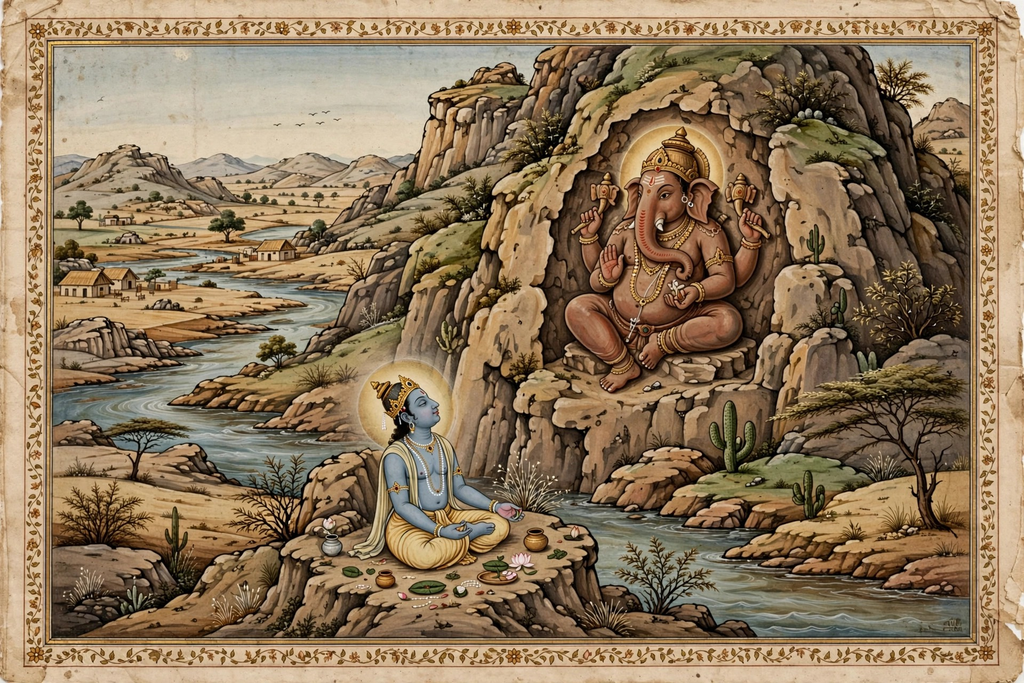
The lore of Siddhatek is tied to the very creation of the world. The ancient stories say that while Brahma was engaged in creation, two formidable entities arose from cosmic waste. Their names were Madhu and Kaitabha, and they began to disrupt the cosmic order. They were not just demons. They were the embodiment of raw, undirected effort — the kind that creates noise but not music.
Mahavishnu engaged them in a battle that lasted for thousands of years, yet victory remained elusive. He had infinite strength, but strength alone was not enough. The demons matched him blow for blow, because they too were born of effort without wisdom.
Vishnu realised that raw effort alone was not enough. He was advised by Shiva to seek the grace of Ganesha on this very hill. Vishnu invoked the Lord with deep focus. He did not ask for more power. He asked for Siddhi — the specific capability, the precise skill required to dissolve this particular Barrier.
With Siddhi, Vishnu achieved his goal on this spot. Therefore, the hill became known as Siddhatek — the Hill of Attainment.
This story holds a profound truth. Effort without alignment is just exhaustion. Vishnu, the preserver of the universe, could not prevail through sheer force alone. He had to pause, retreat, and seek a deeper understanding. Siddhatek is the place where raw power meets refined skill. It is where we stop banging on the door and learn to find the key.
3. The Uniqueness of the Form
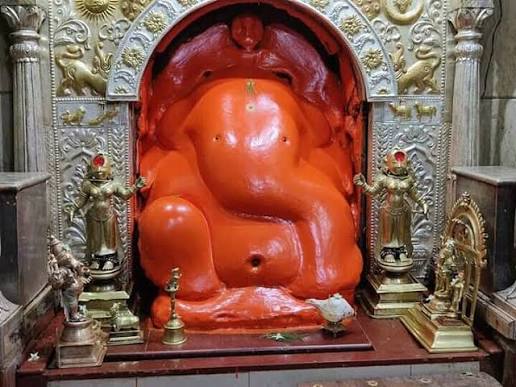
The murti at Siddhatek is particularly striking. He stands apart from most others. He is a massive three-foot form, carved directly into the natural rock face of the hill. He does not sit. He stands. This posture itself is a statement. It is the posture of one who is ready, who is alert, who is prepared to act.
Crucially, his trunk is turned to his right. This is the Dakshinamukhi form, the face of the south, the direction of Yama, the god of transformation and discipline. Shrines with a right-facing trunk represent a highly potent, disciplined, and fiery energy. This form demands absolute purity and deep focus from the seeker. It is not casual. You do not approach Siddhivinayak casually.
His expression is exceptionally fierce yet deeply reassuring. The brow is furrowed, not in anger, but in concentration. He sits anchored, immovable into the mountain itself. There is no gentleness here, no invitation like at Moregaon. There is only a quiet, unshakable readiness. This is not the Ganesha of beginnings. This is the Ganesha of execution.
The fact that he is Swayambhu — self-manifested — and carved from the hill means capability is not imported. It is uncovered. The mountain was always there. The skill was always within the rock. The seeker’s job is to chip away what is unnecessary.
4. The Inward Lesson
Moregaon is about finding our initial purpose. Siddhatek is about building the capability to execute it. Vishnu fought a battle for thousands of years. This reminds us of a deeply human problem: we often rely entirely on raw, repetitive hard work while ignoring the deeper alignment needed for success.
We pull the oars harder without checking if the anchor is still down. We fight the same battle again and again, wondering why the outcome does not change. We call it perseverance. But sometimes, it is just noise.
Siddhivinayak represents the transition from intention to competence. He teaches us that overcoming massive life challenges requires more than just continuous effort. It requires Siddhi, the specific talent, inner discipline, and sharp skill set tailored to the problem at hand.
It is the vital reminder that power without structural alignment is just noise. Siddhatek is where we learn to turn noise into music.
Think of your own “Madhu and Kaitabha.” What is the problem you have been fighting for years with the same tools? A project that won’t move? A relationship pattern that repeats? A habit you can’t break? Vishnu’s victory came not when he fought harder, but when he paused to seek the gift of understanding. He stopped fighting the mountain and learned to move it.
Capability is not about adding more hours. It is about subtracting the unnecessary. It is about asking: What is the one skill I lack for this specific wall? What is the right-facing trunk, the discipline, that this moment demands of me?
At Moregaon we set the Sankalpa. At Siddhatek we forge the tools.
5. The Taste of the Temple
The offering at Siddhatek is distinct from the humble Khichdi of Moregaon. Here, the Naivedya is Sattu, a dry, roasted flour made from chickpeas. It is simple, nourishing, and remarkably practical.
Sattu is the food of travellers and warriors. It does not spoil. It does not weigh you down. Mixed with water or buttermilk, it provides sustained energy for the journey ahead. When you taste it, you understand that this is not a temple of comfort. This is a temple of preparation.
The offering is not sweet. It is earthy, grounding, and honest. It tastes of the soil and the sun. It is the taste of capability. It is the taste of food that fuels you for the long climb, not the taste of dessert that rewards you at the end. Siddhatek does not give you sugar. It gives you strength.
6. The Closing Reflection
True competence is a silent knowledge. It knows exactly when to fight and exactly when to pause. Effort alone cannot break a wall. It requires the right tool and the right focus.
Vishnu’s victory came only when he stopped the redundant battle to seek the gift of understanding. He did not abandon his fight. He simply refined his approach. He traded endless motion for aligned action.
Take a moment to ask yourself today: Are you fighting a mountain, or are you preparing the capability to move it? Sometimes, the bravest thing you can do is to pause, retreat, and seek the skill you lack. The mountain will still be there when you return. But you will return different.
The Bhima flows on, patient and powerful. The hill stands, waiting. Siddhivinayak, right-trunked and fierce, does not promise to make it easy. He promises to make you capable.
From here, the path leads to Pali, where capability must be shielded by courage. But first, stand. Breathe. And prepare.
Author Biography: – R Srinivasa Murthy, the author, is a corporate leader, an independent writer, and a student of Hindhu Philosophy. He Identifies as a Demystic, committed to removing unnecessary mysticism from traditions to offer practical systems for the next generation. His upcoming book, Logic of And: Sanatana Dharma as a Toolkit for the Contemporary Seeker, aims to bridge ancient wisdom with modern life to foster an inclusive, living civilisation.

With a journalistic long journey, we bring you https://primepost.news, a dynamic platform committed to unraveling the intricate tapestry of Indian politics, particularly delving deep into the heart of Telangana and Andhra Pradesh. Our blog is not just a source of news; it’s a reservoir of insights, analysis, and thought-provoking reviews.