Maglev engineering breakthroughs in modern transportation
Human civilisation has always sought to travel faster. From the invention of the wheel to steam locomotives, from diesel engines to electric railways, every technological revolution has attempted to reduce travel time while improving safety and comfort. Yet conventional railway systems continue to suffer from an inherent engineering limitation: steel wheels constantly rub against steel rails, generating friction, wear and tear, vibration, noise, and continuous maintenance costs.
Magnetic Levitation, popularly known as Maglev, represents one of the most remarkable engineering breakthroughs in modern transportation. Instead of allowing the train to run on wheels, powerful magnetic fields lift the train above the track. Since there is no physical contact between the train and the guideway, friction is almost eliminated. The train literally floats above the track and is propelled forward by magnetic forces.
This revolutionary technology enables trains to travel at extraordinary speeds exceeding 500 kilometres per hour, while providing passengers with an exceptionally smooth, quiet and vibration-free journey. The absence of wheels, axles and conventional mechanical transmission systems significantly reduces maintenance requirements and enhances operational efficiency.
The fundamental philosophy of Maglev is simple yet revolutionary: replace mechanical contact with magnetic force.
The Science Behind Magnetic Levitation
Maglev systems primarily operate through two different engineering principles.
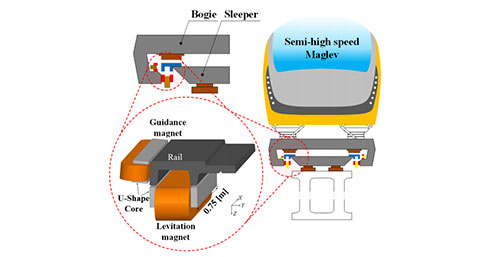
The first is Electromagnetic Suspension (EMS). In this system, powerful electromagnets are installed underneath the train. These magnets attract the steel guideway from below, pulling the train upward. Sophisticated electronic sensors continuously monitor the gap between the train and the track, maintaining a precise clearance of approximately 15 millimetres. Because the magnetic attraction must remain perfectly balanced throughout the journey, advanced computer control systems constantly adjust the magnetic force.
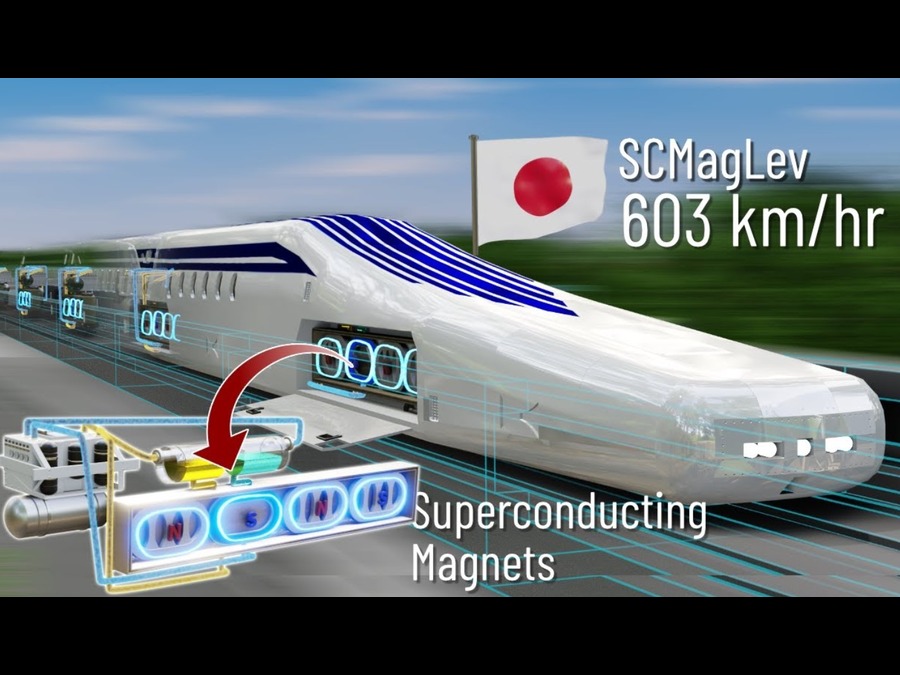
The second technology is Electrodynamic Suspension (EDS), which is even more sophisticated. Instead of attraction, it relies upon magnetic repulsion. Superconducting magnets fitted to the train interact with electrically conductive coils embedded within the guideway. As the train accelerates, powerful magnetic fields create a repulsive force that lifts the train approximately 100 millimetres above the track. This system naturally becomes more stable as speed increases and therefore permits even higher operating speeds.
Regardless of the levitation mechanism, propulsion is achieved through Linear Synchronous Motors. Unlike conventional railway engines that pull the train using rotating wheels, the entire guideway itself functions like an unrolled electric motor. Magnetic waves generated along the track pull and push the train forward with extraordinary precision.
Salient Features of Maglev Technology
Maglev offers several remarkable advantages over conventional railway systems. The complete elimination of rolling friction allows extremely high operating speeds exceeding 500 km/h. The absence of wheels significantly reduces mechanical wear, extending the life of the system while lowering long-term maintenance costs.
Passengers experience a remarkably smooth, silent and vibration-free journey because there is no direct physical contact between train and track. Acceleration and braking are faster and more efficient, making Maglev particularly attractive for high-speed intercity travel. The system is electrically powered, producing no direct exhaust emissions and contributing to cleaner transportation when supplied with renewable electricity. Computer-controlled operation also enhances precision, reliability and passenger safety.
Global Experience
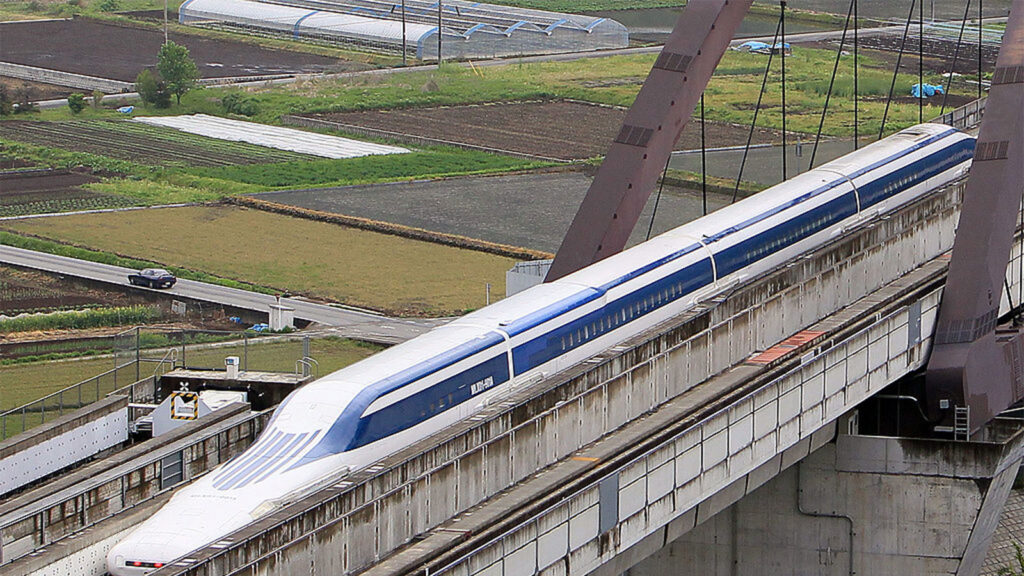
Although Maglev has attracted worldwide attention for decades, very few countries have successfully implemented commercial systems because of enormous construction costs.
China operates the Shanghai Maglev, inaugurated in 2004. Stretching approximately 30 kilometres, it connects Pudong International Airport with the city and reaches operational speeds of 431 km/h, making it one of the fastest commercial rail services in the world. Japan is constructing the Chūō Shinkansen, based on advanced Electrodynamic Suspension technology. The line between Tokyo and Nagoya has been designed for commercial speeds approaching 500 km/h and represents one of the world’s most ambitious transportation projects.
South Korea operates the Incheon Airport Maglev, while China has also introduced the Changsha Maglev for urban transit applications. These systems demonstrate that magnetic levitation canChina also be adapted for lower-speed metropolitan transport. Despite decades of technological development, however, Maglev remains confined to only a handful of specialised corridors worldwide.
The Indian Context
The question confronting India is not whether Maglev works. It unquestionably does. The real question is whether India can presently afford such a technologically advanced system without compromising other developmental priorities.
India continues to confront enormous challenges in healthcare, education, rural infrastructure, drinking water, irrigation, housing, nutrition, employment generation and urban development. Every rupee invested in one sector necessarily limits expenditure elsewhere. Public investment must therefore balance technological ambition with developmental necessity.
Cost of Conventional High-Speed Rail
India’s first Bullet Train project between Mumbai and Ahmedabad employs conventional wheel-on-rail High-Speed Rail technology. The estimated construction cost is approximately ₹200–250 crore per kilometre, making the entire 508-kilometre corridor cost about ₹1.08 lakh crore. Although expensive, this technology benefits from decades of global operational experience and allows gradual localisation of manufacturing, maintenance and engineering expertise.
Estimated Cost of a Maglev Corridor
A comparable Maglev system would require an entirely different infrastructure.
Instead of conventional tracks, specialised elevated guideways fitted with magnetic coils must be constructed throughout the alignment.
Power supply systems become substantially more sophisticated.
Precision engineering tolerances are significantly higher.
Maintenance facilities require specialised equipment unavailable within India’s existing railway ecosystem. Consequently, current international estimates suggest construction costs ranging between ₹400 crore and ₹600 crore per kilometre.
Illustration
Consider a hypothetical 500-kilometre Maglev corridor connecting two major metropolitan cities.
At an average cost of ₹500 crore per kilometre, the project would require:
500 km × ₹500 crore = ₹2,50,000 crore
That is approximately ₹2.5 lakh crore for a single corridor.
This estimate excludes:
* Land acquisition
* Environmental mitigation
* Rehabilitation and resettlement
* Interest during construction
* Future maintenance infrastructure
* Power distribution systems
* Cost escalation
* Rolling stock replacement over time
Including these additional expenditures, the total investment could approach ₹3 lakh crore or more for just one project.
Such expenditure would be nearly three times the cost of India’s first Bullet Train corridor.
Opportunity Cost
Economics teaches that every public investment carries an opportunity cost.
The same ₹3 lakh crore could alternatively finance:
* Thousands of government schools.
* Hundreds of modern district hospitals.
* Rural drinking water projects.
* Irrigation networks.
* National highways.
* Metro rail systems across several cities.
* Railway modernisation and safety upgrades.
* Affordable housing programmes.
The question is therefore not whether Maglev is technologically superior, but whether it represents the best use of scarce public resources at India’s present stage of development.
Network Compatibility
Another significant limitation concerns interoperability.
India possesses one of the world’s largest railway systems, extending over 68,000 route kilometres.
Conventional High-Speed Rail can be integrated, where appropriate, with existing railway infrastructure, maintenance ecosystems, manufacturing facilities and operational expertise.
Maglev cannot.
Its guideways, trains, depots, signalling systems and maintenance facilities are entirely proprietary.
Every kilometre of infrastructure must be built from scratch.
This technological isolation substantially increases long-term operational complexity.
Land Acquisition Challenges
High-speed transportation demands exceptionally straight alignments with gentle curves. India’s densely populated villages, agricultural lands and expanding urban settlements make acquiring continuous corridors extremely difficult. Every kilometre may involve negotiations with hundreds of landowners. Compensation disputes, rehabilitation challenges, litigation and political opposition often delay infrastructure projects for years while substantially increasing costs.
Passenger Economics
Infrastructure survives only when people can afford to use it.
India remains a price-sensitive transport market.
Millions depend upon subsidised railway travel.
Maglev requires very high passenger fares to recover construction and operating costs.
If ticket prices become comparable to commercial air travel, the service may primarily cater to affluent travellers rather than functioning as genuine mass transportation.
This creates a serious economic mismatch between technological capability and demographic affordability.
Can India Afford Maglev Today?
From a purely engineering perspective, India certainly possesses the scientific talent to understand, operate and eventually manufacture Maglev technology.
From a fiscal perspective, however, the answer is considerably more complex.
Constructing even one major Maglev corridor would require investment running into several lakh crore rupees.
Given India’s developmental priorities, such expenditure would impose considerable pressure on public finances.
For the foreseeable future, conventional High-Speed Rail provides a far more balanced solution by delivering speeds of around 320 km/h, lower capital costs, proven reliability, easier maintenance and greater integration with existing railway infrastructure.
India’s Strategic Roadmap
India’s long-term transportation strategy should proceed in two complementary directions.
First, successfully complete ongoing High-Speed Rail projects such as the Mumbai–Ahmedabad Bullet Train corridor. These projects help develop indigenous engineering capabilities, domestic manufacturing, skilled manpower and modern railway technologies.
Second, continue investing in indigenous research into magnetic levitation, superconducting materials, linear motor technology and urban transit applications through Indian Railways, academic institutions and national research laboratories. Such research enables India to build intellectual property, reduce future technological dependence and prepare for eventual adoption when economic conditions become more favourable.
Conclusion
Magnetic Levitation is undoubtedly one of the greatest transportation innovations of the twenty-first century. It offers extraordinary speed, exceptional passenger comfort, minimal mechanical wear and impressive engineering elegance. It represents what rail transportation may eventually become. Yet every nation must adopt technology according to its economic capacity rather than technological fascination.
For India, where developmental priorities remain vast and public resources finite, investing immediately in nationwide Maglev corridors would be economically difficult to justify. A single 500-kilometre project could require investments approaching ₹3 lakh crore, funds that might otherwise transform healthcare, education, rural infrastructure and conventional rail modernisation for millions of citizens.
India’s immediate priority should therefore remain the expansion of conventional High-Speed Rail, strengthening railway safety, modernising existing infrastructure and simultaneously nurturing indigenous Maglev research. This balanced strategy preserves fiscal prudence while ensuring that India remains technologically prepared for the future.
The future of transportation may indeed belong to magnetic levitation. The challenge for India is not whether to embrace that future, but when to do so. Sound economics demands that technological aspiration should always be guided by national priorities, social equity and long-term fiscal sustainability.

M. Shiva Prasad, IPS (Rtd.) is a dedicated law enforcement professional who served the combined Andhra Pradesh cadre before opting for the Telangana cadre. Though a native of Andhra Pradesh, he considers himself a true Hyderabadi with an abiding love for the Telugu people. Driven by sincerity, fearlessness, and a lifelong fight against inequality and injustice, his ultimate strengths remain his goodwill and deep affection for the public and the police force. Today, he continues his mission by writing snippets and articles true to his conscience.
Email: Shivareach@yahoo.com
Mobile: 98480 38774