(Part 5)
The Tirumala Tirupati Devasthanams (TTD) is not merely a religious institution. It is a public trust, governed by statute, sustained by public money, and accountable under the Constitution of India. When allegations surfaced in 2024 regarding adulteration of ghee used in the sacred Tirumala laddu, the issue ceased to be a matter of faith alone—it became a test of constitutional governance, institutional integrity, and the rule of law.
Salient Points of the ICAR-NDRI Report: Four sealed ghee samples taken from Tirumala Tirupati Devasthanams (TTD) supply tanks on 6 July and 12 July 2024 were analysed. These samples were sent to ICAR-NDRI, Karnal, specifically to test for the presence of lard and other animal fats using a PCR-based method.
The ICAR-NDRI report dated 16 May 2025 did not detect any animal fat (e.g., lard or beef tallow) in any of the four ghee samples.
However, the samples were still found to be adulterated with vegetable oils and other non-dairy substances that are used to artificially mimic the chemical profile of pure ghee. This does not prove animal fat was present, but it confirms adulteration with non-dairy additives. PCR tests are used to identify biological markers of animal fats; a negative result here means no biological evidence of animal-derived fat was found. Ghee adulteration often uses vegetable oils, chemical esters, and fatty substances to resemble dairy fat in quality checks — making it difficult to spot without sophisticated testing.
ICAR-NDRI as of Jan 2026
This directly counters earlier political and media claims that beef fat or similar animal derivatives had been used in the sacred laddus. Instances of adulteration were confirmed, but with vegetable oils or other non-animal components that are not traditional or legally acceptable in pure ghee. The ICAR-NDRI findings provide scientific clarity that no animal fat was used, which matters deeply for devotees’ religious sensitivities. Allegations that animal fat was used, even if later disproven, caused deep distress among millions of devotees who regard the laddus as sacred and symbolically pure. The controversy became highly politicised, with accusations and denial battles among political parties, amplifying misinformation and public confusion.
TTD’s reputation, as well as public trust in procurement and quality checks, was damaged because cheap or adulterated ghee was supplied and passed through procurement without being promptly detected.
TTD’s institutional failure
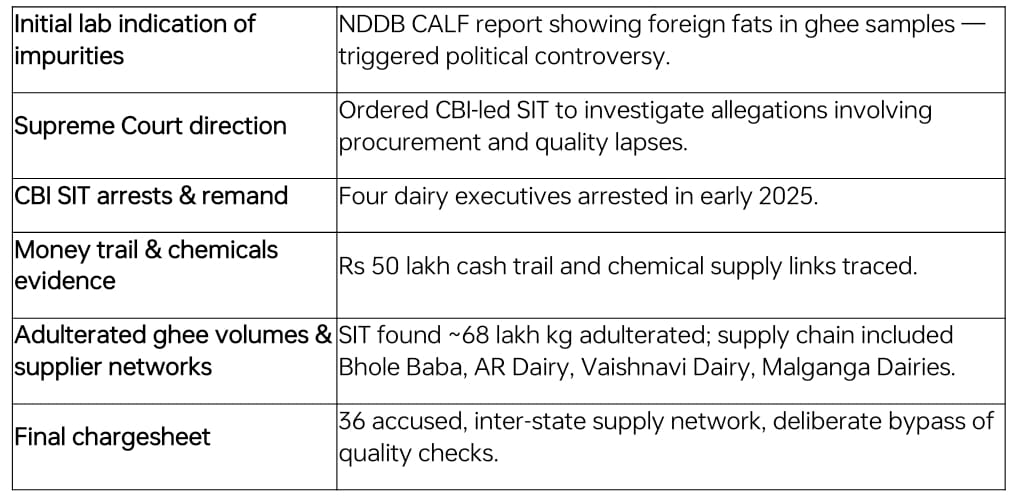
The scale, over 68 lakh kg of adulterated ghee supplied between 2019 and 2024—raised serious constitutional questions. How did internal audits fail? How were public contracts manipulated? Article 299 demands transparency and probity in government contracts. Its violation here was systemic, not incidental. The larger probe found that ghee worth roughly ₹250 crore may have been supplied to TTD over 2019–24, involving adulterants like palm oil, palm kernel oil, and chemical additives. The controversy should prompt TTD to strengthen quality control measures including setting up a dedicated food testing lab at Tirumala with advanced instruments (GC, HPLC) to check raw material quality.
The 11-Page SIT Investigative Report (Feb 2026)
This report, submitted to the Andhra Pradesh government, details the operational failures and collusion. It highlights the dilution of tender norms, which allowed ineligible dairies to supply substandard products. It documents collusion between TTD procurement staff and external dairy experts to facilitate the supply. The report recommends strict legal and disciplinary action against TTD officials and board members involved in the procurement process between 2019 and 2024.
TTD Internal Audit Report (2022-2024)
Internal reviews, although initially ignored, confirmed discrepancies in supply. The TTD found that 89,121 ghee packets were sold, but payment for only 75,000 were recorded, indicating a missing trail for over 13,000 packets. The report confirmed that, despite complaints, necessary tests for detecting adulteration (like GC and HPLC tests) were not conducted in the TTD laboratory.
2025: From Sacrilege Narrative to Procurement Fraud
As the investigation progressed, the narrative shifted. Scientific analysis did not conclusively establish the presence of animal fat. Instead, the SIT uncovered large-scale adulteration using vegetable oils and chemical additives, enabled by falsified lab reports and compromised procurement procedures.
This transformed the issue from a religious controversy into a textbook case of institutional corruption.
January 2026: Due Process over Rhetoric
The final chargesheet filed in January 2026 named 36 accused, including suppliers and internal officials. Crucially, it closed the chapter on unverified claims of animal fat while firmly establishing economic and administrative crimes. Justice, though delayed, remained anchored to evidence.
The Tirumala laddu controversy teaches a constitutional lesson: when institutions fail, faith is weaponised; when courts intervene, reason is restored. The Constitution—not sentiment—is the ultimate guardian of both belief and governance.

Law professor and eminent columnist
Madabhushi Sridhar Acharyulu, author of 63 books (in Telugu and English), Formerly Central Information Commissioner, Professor of NALSAR University, Bennett University (near Delhi), presently Professor and Advisor, Mahindra University, Hyderabad. Studied in Masoom Ali High School, AVV Junior College, CKM College, and Kakatiya University in Warangal. Madabhushi did LL.M., MCJ., and the highest law degree, LL.D. He won 4 Gold Medals at Kakatiya University and Osmania University.
Email: cicsridhar@gmail.com
Mobile: 8447651505