Archaeologist Dr. Sivanagi Reddy identified it as petrified wood
is being sent to the Hyderabad lab for extensive examination
An extremely rare and ancient fossil, estimated to be around 50 million years old, has been discovered on the premises of the Ramalayam (Rama temple) near the railway station in Madhira. Renowned archaeologist Dr. Emani Sivanagi Reddy identified the stone, which is believed to be petrified wood (Daru Shilajam).
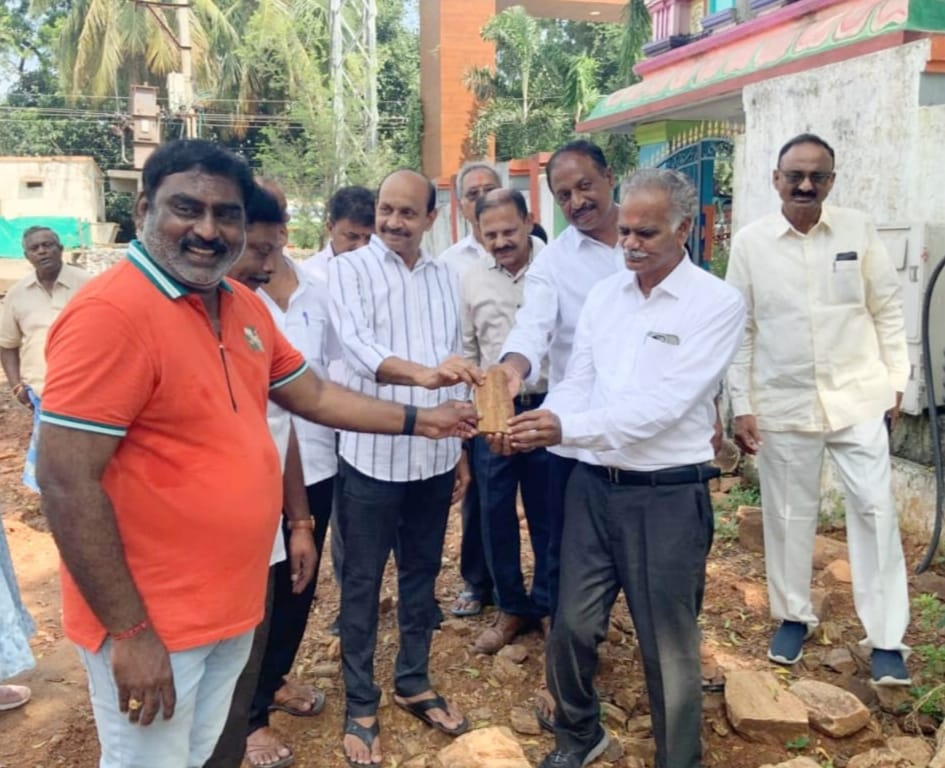
The discovery was made on Sunday during a visit by Dr. Sivanagi Reddy, who is a prominent Vastu consultant, CEO of the Amaravati Buddha Vihara, and former Chief Advisor for the Telangana State Nagarjuna Buddha Vanam project. He was invited by the temple’s Reconstruction Committee, recently formed by railway officials and town dignitaries, to provide advice and suggestions for the reconstruction of the ancient Ramalayam.
During his inspection, Dr. Sivanagi Reddy examined an old rock that had been unearthed. Upon scrutinising the stone, he identified it as an ancient fossil, dating back approximately 5 crore years. He stated that it is known as petrified wood. Given its immense antiquity and historical value, the temple Reconstruction Committee, alongside the archaeologist, was astonished by the finding. Dr. Sivanagi Reddy announced that the fossil would be sent to a Hyderabad lab for extensive and detailed analysis. Prominent town members, including Kona Janardhan Rao, Malladi Vasu, Suramsetti Kishore, Miriyala Ramana Gupta, Patibandla Satyam Babu, Katikala Sitaram Reddy, Karnati Ramarao, and Bhanu Prakash, were present during the examination.
How Fossils Form
Fossils are the preserved remains or traces of ancient organisms plants, animals, and microbes—typically found embedded in sedimentary rock. The process of fossilisation is rare, requiring a specific set of circumstances to occur. For an organism to become a fossil, its remains must be buried quickly by sediment (like mud, sand, or silt) soon after death. This rapid burial prevents decomposition, scavenging, and weathering. Organisms with hard parts like bones, shells, and wood are much more likely to be preserved than those with soft tissues.
The most common way fossils form is through permineralisation. Here, water rich in dissolved minerals seeps into the porous tissues (like bone or wood). As the water evaporates or moves away, the minerals crystallise and fill the empty spaces within the original tissue. Over millions of years, the original material is replaced by these minerals, turning the remains into rock while preserving the organism’s original structure. Other types of fossil formation include moulds and casts, where the original remains dissolve, leaving an imprint (mould) which is later filled by new minerals (cast), and compression, where the organism is flattened and a carbon imprint is left in the rock (often seen in plant fossils).
Deputy Editor, Prime Post
Anand Gantela is a seasoned media professional with nearly three decades of experience across the spectrum of Indian journalism. Having worked extensively in both print and broadcast media, he has held key positions at renowned outlets such as Prajashakthi, Andhra Bhoomi, Mudra, Media India, Siti Cable, Mana Telugu, and Maa TV. From ground-level reporting to managing news bureaus and overseeing bulletin production, Anand has witnessed the evolution of news firsthand. His wealth of experience reflects a deep understanding of the dynamic and ever- evolving landscape of news reporting.


I am astonished to learn that five crore year fossil was found in Madhira temple. It’s interesting. Let us wait for the report which been sent to Archeological Department, Hyderabad. A good and fascinating news item.