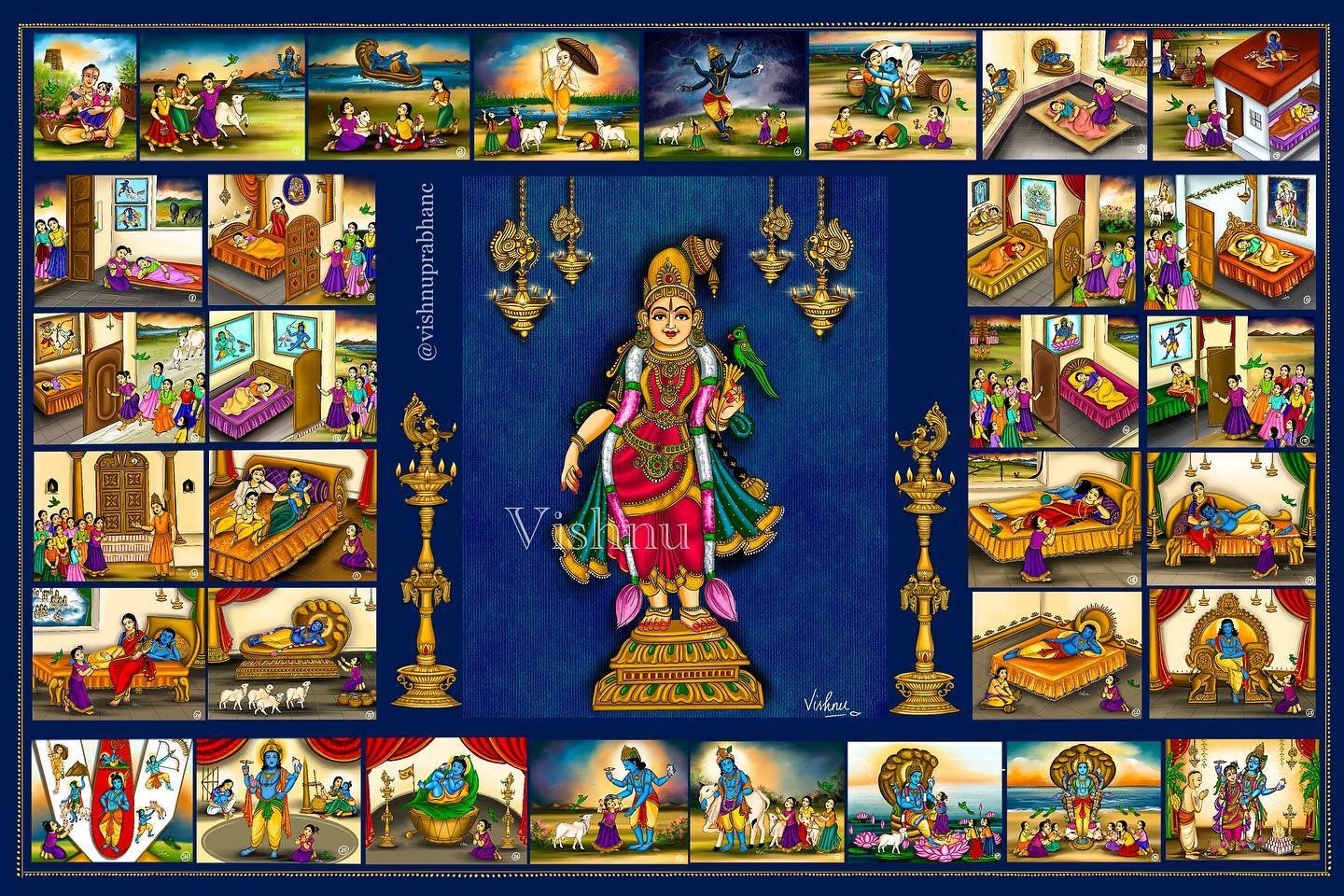
Divine parts of Srimad Bhagavatham & Srimadramayanam in Tiruppavai
A dwarf who grew to measure the Universe
Goda’s Tamil Paashuram 3
Ongi Ulagalandha Utthaman Per Paadi
Naangall Nampavaikku Chaattri Neeradinal
Theengindri Nadellam Thingal Mummaripeydhu
Ongu Perum Sennnelloodu Kayalugala
Poonkuvalai-p-podil Porivandu Kannpaduppa
Thengathe Pukkirindhu Seertha Mulai Pattri
Vaanga-k-kudam Niraikkum Vallall Perum Pasukkal
Neengade Selvam Niraindhu-el-or em Paavaai
English Poem 3
Sing of the dwarf who grew to measure the Universe.
As a holy bath cleanses the heart to intensify the prayer.
Three rains a month to raise the wealth of crops.
Where fish flourish with joy in farm waters, and
Where bees doze within the folds of white lotuses
Grown-up and healthy cows in herds are ready and
Generous enough to splash the streams of milk filling the pots
Wealth Unlimited greets all of us. Come & join my girls.
Rama’s Vow
In the Tiruppāvai, themes from the Rāmāyaṇa, Mahābhārata, and Bhāgavata subtly surface again and again. The word Uttaman means Puruṣottama—the Supreme Person. Whether it is Rama in Ayodhya, in the forest during exile, or Krishna in prison or in Dwaraka, both attain the supreme abode. Be it Rama, Krishna, or Vamana who comes as a mendicant, all are none other than Srimannarayana.
Even if He assumes a humble or seemingly lowly form, Hari protects His devotees. That is why He is Uttama, Puruṣottama. Rama tells Sita that he would give up even his life, even Sita and Lakshmana, but would never abandon the vow he made—to free the sages from the torment of the demons. That is the hallmark of uttama character. At the end of Rama’s incarnation, when he invites Hanuman to accompany him to Vaikuntha, Hanuman replies that he cannot leave Rama’s friendship, his feeling of devotion, or the name of Rama. Thus Hanuman becomes a Chiranjivi, destined to live on. There is no separate act of granting or taking moksha—Rama’s name alone is enough.
How Supreme are Rama and Krishna
Though born in a Kshatriya lineage, Krishna did not hesitate to grow up as a cowherd. He cast aside caste identity itself. How noble is Sri Krishna! It is by glorifying the names of that Puruṣottama that the sacred vow begins. By chanting Govinda’s name, Draupadi received an unending stream of garments. With Rama’s name, Hanuman crossed the ocean effortlessly, whereas Rama himself could not cross it without building a bridge.
Trivikrama
He is Trivikrama the one who measured the three worlds in two strides. If one bathes and observes the vow while praising that Vamana, there will be no afflictions. Timely rains will fall; paddy fields will flourish, yielding red, healthy grains. In the water-filled fields, fish will leap joyfully. Beautiful bees, intoxicated by the nectar of lotus flowers, will drift into blissful sleep. Livestock, too, will thrive. Well-nourished cattle will come close without hesitation; as soon as the cowherds grasp their udders, milk will gush forth, filling pots to the brim. Inexhaustible prosperity will abound.
Would anyone willingly assume the form of a dwarf? Would the Supreme be born as a beggar? The Lord, free of all defects and possessed of a transcendental body, came as Vamana to rescue His devotees and to restore to the gods the kingdom unjustly seized by Bali. When Bali promised three paces of land, Vamana grew immeasurably large. With just two strides, he measured the many worlds. He is Puruṣottama. The gopikas are ecstatic, marveling at how exalted the Supreme Abode became Vamana for the sake of His devotees.
The One Who Serves Others Is the Supreme
In this sankeertana, Annamacharya describes the greatness of Vishnu’s feet—feet washed by Brahma; feet that are Brahman itself; feet that are the very abode of the Supreme Self, the seat of knowledge. In the Treta Yuga, Vishnu appeared as Vamana, the dwarf, the first human form of Narayana. In this world, there are the superior, the middling, and the base. Those who harm others for selfish gain are base. Those who wish for their own well-being along with that of others are middling. But the one who serves others without counting even his own life—that person alone is uttama.
Vaamana, another form of Naaraayana, was a short boy – Vatuvu (one who is at the start of Vedic education) who secured the charity of three feet of land from King Bali, and then started growing up and up to measure the entire universe. He demands the place for the third foot of land, and, bowing down, Bali shows his head. Bali is sent to the underworld (Paataal) as punishment for his expansionism and eviction of Indra. Praise him, we will not have any problems in our country. Come on, my friends, let us do this Vrata. We will have three rains a month. Paddy grows fabulously. The fish jumps with joy in the green farm-field waters. Beautiful white lotuses blossom and attract the bees to sleep in the folds of their petals peacefully. Milking animals are no less in number, and several herds of cows are so kind that they yield the milk unasked and without any extraction. They yield many pots of milk. The vast wealth, unlimited and ever-growing, is the reward of the Lord’s generosity.
In the first Paashuram, Goda explains that the Bhagavan lives in Naaraayana Tatwa. In the second, she has shown Milky Ocean as His second Sthana, and now in the third, Goda explains the ‘place’ of God in his various forms–Avataras, which are called Vibhavamulu. God never hesitates to take any form like a fish, tortoise, boar, dwarf, etc, to help the good and end the bad. He is the best personality, Purushottama, the best of all beings.
In his exile also Raama was also holding his bow and arrows beside a Sword etc. Surprised, Seeta asks: “Are you an ascetic who is expected to spend 14 years in forests doing penance?” Raama asks, “Why do you doubt?” She answers: “Where is the need for arms for a man who is supposed to silently pray like a Rishi?” Then he smiles and explains: “Dear Seetha, listen to me, I vowed to safeguard ascetics in the forest to free them from miseries caused by Demons. It is my Vratam…” to fulfil my promise. Raghukul Reeti Sadaa Chali Ayee, Praan Jaaye Par Vachan na Jaaye” (It’s the tradition of the Raghu clan all along, that they may afford to lose life but not the word given). Come what may, even if I lose you (Seetha), or my dear Lakshman, I will perform my duty; hence I am ready with arms anytime”. That is the Greatness of benevolent Raama.
Krishna, the God himself, born to a princely class, prefers to live with cowherds. He never minds about the level or the caste. Krishna was so kind that he granted an ending flow of clothes to Draupadi when she prayed, addressing him as Govinda, in the worst crisis. Chanting the name of Raama made Hanuma cross the Ocean in one leap, whereas Raama could not cross it unless the bridge was built by his army. It means His name is more powerful than He Himself. Let us chant his name and attain all peace and glory.
This poem refers to Raama and Krishna, besides explaining the power of Vaamana. Mantras might have stringent restrictions for chanting. But singing the name of God is easy and free from all limitations. Anybody at any time can spell His name. Gopikas were asked to come and bathe in the early hours with the chanting of Narayana Naamam. It will relieve them from the pangs of separation from Sri Krishna. Once you get into it there is no dearth for anything, says Goda.
This poem refers to Raama and Krishna, besides explaining the power of Vaamana. Mantras might have stringent restrictions for chanting. But singing the name of God is easy and free from all limitations. Anybody at any time can spell His name. Gopikas were asked to come and bathe in the early hours with the chanting of Naarayana Naamam. It will relieve them from the pangs of separation from Sri Krishna. Once you get into it there is no dearth for anything, says Goda. – Madabhushi Sridhar
Law professor and eminent columnist
Madabhushi Sridhar Acharyulu, author of 63 books (in Telugu and English), Formerly Central Information Commissioner, Professor of NALSAR University, Bennett University (near Delhi), presently Professor and Advisor, Mahindra University, Hyderabad. Studied in Masoom Ali High School, AVV Junior College, CKM College, and Kakatiya University in Warangal. Madabhushi did LL.M., MCJ., and the highest law degree, LL.D. He won 4 Gold Medals at Kakatiya University and Osmania University.