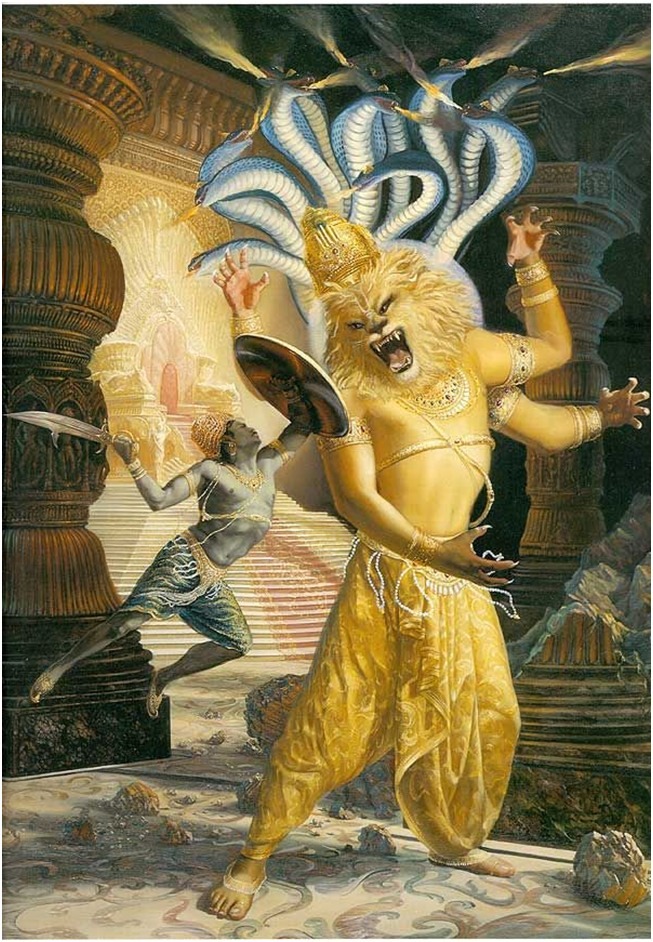
Yadu Simha walks towards the throne
Maarimalai Muzhainjil Manni-k-kidandhurangum
Seeriya Singam Arivuttru-th-thee Vizhiththu
Verimayirponga Eppaadum Perndhthari
Moori Nimirndhu Muzhangi-p-purappattu
Podharuma Poley Nee Poovai-Ppoovanna! Un
Koil Ninru Ingane Pondharuli Koppudaya
Seeriya Singaadhanath-thirundhu Yam Vandhakaariyam
Aaraindhu Arul-el or empaavaai.
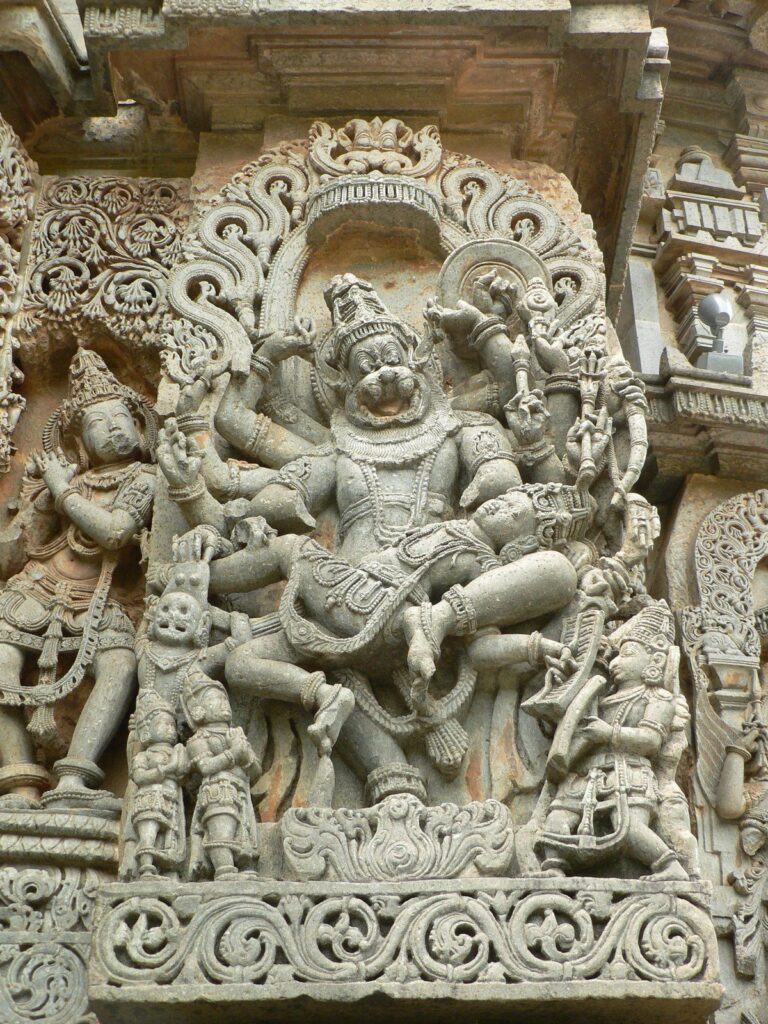
English Translation by Madabhushi Sridhar
In a mountain den, the fierce Lion
Spending winter in sleep with a lioness
Opened fire-emitting eyes, erect,
Straightened fragrant hair to all directions,
Stretching the mane, with a roar for starting
As blue lotus eyes shine, it is stepping out with a bang.
From your abode towards the divine
Throne exquisite, to settle on and bless us.
The context:
Until yesterday, the Gopis sought the Lord’s graceful glances. They pleaded with Him to slowly open His eyes and look upon them. Shri Krishna, feeling a touch of regret for having neglected these devotees who came with Neela Devi, asked them what they desired. The Gopis, yearning to see the majesty of His gait, requested Him to walk towards the throne like a lion.
Analysis of 23rd Pashuram, Maarimalai Muzhainjil
A majestic lion, Sri Krishna
Shri Krishna is the Lion of the Yadus. Just as a majestic lion, sleeping in a mountain cave during the monsoon alongside its mate, wakes up with fire-spitting eyes, shakes its fragrant mane, stretches its limbs, roars in all directions, and strides out—O Krishna, who possesses the hue of the flax flower (Atasi), emerge from Your inner chambers, occupy this extraordinary throne, and grace us by inquiring into our purpose.
This describes the awakening of the “Krishna-Lion” who slept embracing Neela Devi. Just as a lion dwells in a cave, Krishna is said to reside amidst the “high mountain-like” presence of Neela Devi.
Both Rama and Krishna are the Lions of Valor
Shri Rama spent the entire monsoon season alone in the caves of Malyavantha Mountain. Both the Yadava-Lion (Krishna) and the Raghava-Lion (Rama) are fearless warriors. Even in sleep, they are “Shaurya Simhas“ (Lions of Valor) who torment their enemies. Here, Krishna is the lion-cub of Yashoda. He rises instantly upon hearing the cry of the distressed. He does not need a set time to wake; He awakens Himself when required.
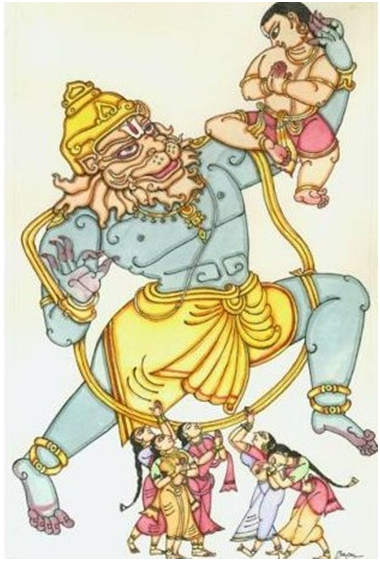
Bapu draws a wonderful picture with great imagination. It is really a creative art to bring a smile to the face of Simha without losing ferocity.
NarashaardoolaKausalya Suprada Rama … Suprabhatam
Rama’s beauty enchanted Kausalya while He slept in Ayodhya; later, Vishwamitra was captivated by the sleeping Rama in the forest, chanting the
- “Kausalya Supraja Rama, Poorva Sandhya Pravarthate,
- Utthishta Nara Shardoola, Kartavyam Daiva Mahnikam”.
Yashoda, too, would lose herself in the beauty of the sleeping Krishna. The hero of this Pashuram is the “Yadu-Lion” in the act of awakening.
This is Valmiki Shloka written for Viswamitra. Tirumala Lord’s Suprabhatam starts with this shloka. Not only this, all other suprabhatams in Vishnu Temples in India start with this aadikavi Valmiki Shlokam, Vishwaamitra calls him Narashaardoola — Lion among men. In Ramayana, Valmiki admires Rama with expressions like Purusharshabha, Rama Saardulam, Matta Maatanga Gaaminam, Simha Vikraanta Gaaminam.
They want to see the transformation of Energy from sleeping posture to kinetic process. He is Narasimha. Till yesterday, they likened His eyes to lotuses. Today, they are emitting fire. Gopikas like the fiery looks of Hari against the enemies of the devotees. Other than those who had no other desires, none can watch the sight of His fiery eyes just as one cannot see the bright Sun.
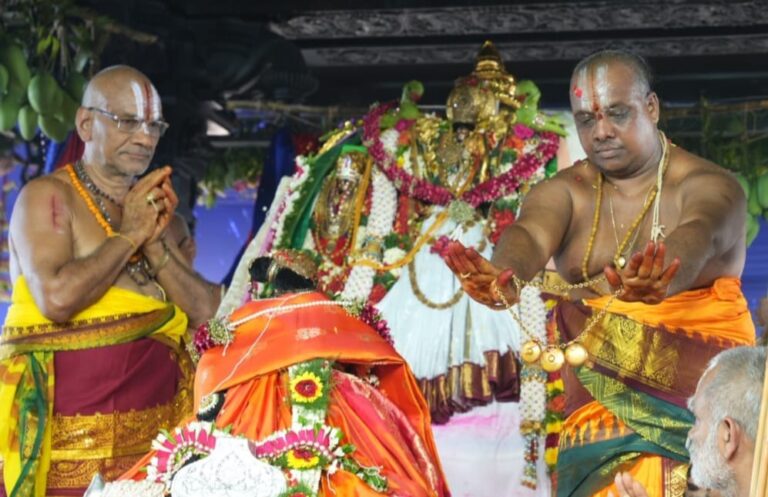
The Yadu Simha woke up, stretched the body, shook the mane, roared like bursting cloud, breaking the hearts of enemies, stepped out of his Palace, gracefully started moving towards his well decorated Singhasana, even as Gopikas call him O Lion of Yadava Clan, the Valiant Hero, please come and settle on the grand chair and consider our desire and purpose of our vrata.
Chaturgathi
In Vishnu Sahasranamam, one of the thousand names of Vishnu is Chaturgati. His movement is described in four kinds – (1) the gait of an elephant – heavy and stolid signifying ponderous strength; (2) the gait of a lion, majestic and imperious, signifying valour: (3) the gait of a bull, steady and indifferent, signifying hauteur; and (4) the gait of a tiger, fierce and agile, signifying rage, as explained by Sri Bhashyam Appalacharya. In the Sri Ranganatha temple, Ranganatha’s palanquin is moved in these four kinds by the bearers.
Narasimha: The Lion’s Prowess:
While all the Avatars of Narayana are pleasant and kind, Narasimha is furious and fearsome. When Prahlada replied to his father Hiranya Kashipu that Vishnu is all-pervasive and could be found in anything around him, Vishnu was particular about the veracity of the devotee’s word. In contrast, Prahlada was tense about whether God’s all-pervasive character gets established or not. Vishnu resolves to attest to the words of his devotee. But Hari was not sure which object the King would choose for the presence of Sarvantaryami. He may pick up whatever comes to his mind at random.
God took care that every object and being in the palace and the surroundings would give rise to His form. When Hiranya Kashipu wanted to find Hari in a pillar, He came out of a non-living thing, without parents, as soon as the devotee wanted, in a ferocious form unprecedented, which is neither an animal nor a man, to protect the good and punish the wicked immediately, thus making possible the impossible. Narasimha is a unique form of self-manifestation chosen for that occasion.
Brahma, Indra, and other celestial personalities fear that kind of Avatara, and could not go nearer to Him, seeing the terrific way of killing Hiranya Kashipu with nails on the threshold in twilight, the Sandhya time. Even at his concert, Lakshmi was terrified and could not venture near him. Brahma advises Prahlada to pacify Narasimha, as He was born for the sole purpose of protecting him from his own father. Prahlada, though frightened, collects the courage to prostrate before Him. The anger vanishes, and the Lion smiles. He lifts the boy and blesses him with his hand on his head.
Thus, a lion does not lose its valor even while asleep; people fear it just by looking at it. Sita describes Rama as “Sukhasuptah Parantapah”—one who torments enemies even while sleeping blissfully. The term “Siriya Singam” implies a lion whose prowess never diminishes and who is always with Lakshmi.
A pure mind is essential for the Vratam deals with 1 to 22 Pashurams
First, Goda describes how Vrata has to be performed. The terms and conditions include pure mind, no indulgences, offerings of flowers and prayers through the Lord’s songs, praise, and chanting of His names through our lips and with all enveloping thoughts of Krishna in our minds. She says that this kind of worship, the rains and prosperity will be bestowed on the land and the people, in the first five Pashurams 1-5.
In the second part, Goda goes on waking up the ten girls, with unique qualities, showing many signs of the dawn and conveying the objective of worshipping and explaining the glorious attributes, valour, and virtues in songs 6-15.
Then, Goda approaches the abode of Krishna, seeks permission of the doorkeepers, wakes up Nandagopan and mother Yashoda, and enlists the support of Nappinna Piratti in six pashurams – 16- 21. Next, Goda and Gopikas pray to Krishna to wake up in Songs 22-23. In Song 17, the mantra and its artha (meaning) were explained, invoking Lakshmi’s kindness in Song 18 and in 19th song, Goda says there is no alternative to Gopikas other than reaching out to Narayana; in Song 20 Gopikas explain that they have shed self-love; they declare their eligibility in Song 21 and request for considering their prayer in song 22.
Pancha Bhoota, as Sri Krishna moves
The commentary explains that as soon as the Lion wakes, the Supreme Being resolves to take many forms. From that resolve comes Tejas (Fire/Light, Kanthi), from Light comes Water, and from Water comes Earth (Prithvi). “Ti“ represents Tejas, and “Veri” represents fragrance (the attribute of Earth, Sugandha). These elements combine to form the Anda (Cosmic Egg), and Brahma emerges. The Lord, as the Antaryami (In-dweller), conducts the process of creation through Brahma. The stretching and stepping forward symbolize the act of Srishti (Creation). When the body is curled up, creation is latent; when He stretches, Nature (Prakriti) becomes manifest. His roar is the act of giving the Vedas to Brahma.
Samaja Vara Gamana (The Majestic Gait)
Just as Tyagaraja praised Him as “Samaja Vara Gamana” (one with the gait of a majestic elephant), the Gopis wish to see Him walk with the gravity of an elephant. The Gopis have seen the beauty of the sleeping Krishna and the grace of His opening eyes; now they long to see the grandeur of His walk and His sitting on the throne.
The lion in the cave represents the Karana Tattva (The Causal Principle)—the Lord in a subtle state with Nature and Souls. The lion emerging from the cave represents the Karya Tattva (The Effectual Principle)—the Lord in the gross state of the manifest universe.
Analysis of Sri Vaishnava Principles
The commentary highlights several core tenets of Vishishtadvaita:
- Five Forms of God (Paradi Panchaka): The text touches upon Para (Supreme), Vibhava (Incarnations like Rama/Krishna), Antaryami (In-dweller), and Archa (The Idol). The transition from the cave to the throne symbolizes the Lord moving from His inaccessible Para state to the accessible Archa state for His devotees.
- Acharya Abhimana (The Role of the Teacher): The throne (Simhasana) is identified as the Acharya (specifically Bhagavad Ramanuja). The Gopis ask Krishna to sit on the throne, implying that the Lord is best approached and most “visible” when He is seated upon the seat of the Guru.
- Creation (Srishti): The lion’s awakening is a metaphor for the Lord’s resolve (Sankalpa) to become many. The mention of the elements (Tejas, Water, Earth) aligns with the Tattva-traya (Soul, Matter, God) philosophy.
- Purushakara (Mediation): Neela Devi’s presence is crucial. In Sri Vaishnavism, the Divine Mother (Sri, Bhu, Neela) acts as the mediator between the erring soul and the righteous Lord.
Literary Elements (Alankaras)
The script uses rich imagery to create a sensory experience of the Lord’s majesty:
- Rupaka Alankara (Metaphor): The primary ornament is the Simha-Rupaka. Krishna is not just like a lion; He is the Yadu-Lion. The cave is the heart/Vedas, and the roar is the Vedic sound.
- Swabhavokti Alankara (Realistic Description): The vivid description of the lion waking up—opening fire-lit eyes, shaking the mane, stretching limbs (Vidal-virichi)—is a classic example of Swabhavokti, where the natural actions of a creature are described with poetic precision.
- Upama (Comparison): Comparing Krishna’s complexion to the Atasi (flax) flower and His gait to a Samaja (elephant) provides a contrast between His toughness (lion-like) and His beauty/grace (flower/elephant).
- Virodhabhasa (Apparent Contradiction): The description of Him being “soft as a flower” yet “intense as a spark of fire” (Poovuvale mettaga, Agnikanamvale teevranga) highlights the Vaichitra (uniqueness) of the Lord’s character, specifically the Narasimha-tattva.

Law professor and eminent columnist
Madabhushi Sridhar Acharyulu, author of 63 books (in Telugu and English), Formerly Central Information Commissioner, Professor of NALSAR University, Bennett University (near Delhi), presently Professor and Advisor, Mahindra University, Hyderabad. Studied in Masoom Ali High School, AVV Junior College, CKM College, and Kakatiya University in Warangal. Madabhushi did LL.M., MCJ., and the highest law degree, LL.D. He won 4 Gold Medals at Kakatiya University and Osmania University.