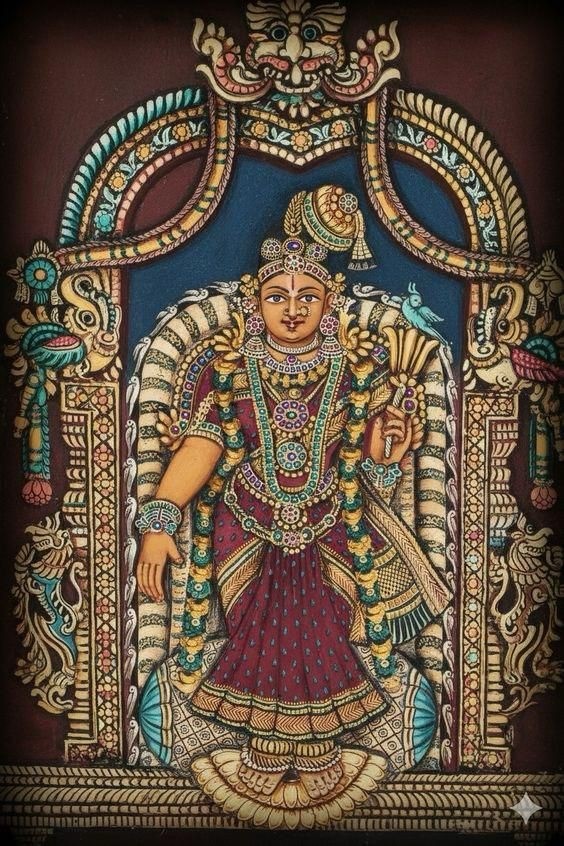
The inseparable unity of Śrī and Nārāyaṇa
Tiruppavai by Godadevi from Tamil
Kuthuvilakkeriya-k-kottukkaal Kattil Mel
Methhenra Pancha Sayanathil Meleri
Koththalar Poonkuzhal Nappinnai Kongaiymel
Viththu Kidantha Malar Maarbhavaai Thiravaai!
Maiththadam Kanninnaai, Nee Un Manaalanai
Ethanai Podhum Thuyilezha Vottaai Kaan
Ethanai Yelum Pirivaatrakillaaiyaal
Thathuvamanru Thagav-el or Empaavaai
English Translation by Madabhushi Sridhar
Clusters of oil lamps burning bright,
On a sculpted cot with four ivory legs,
On a cool, white, soft bed of five merits,
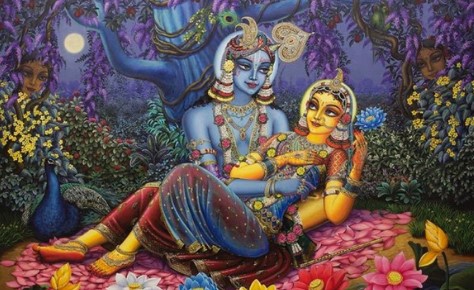
On the bosom of Neela with flower-decked plait,
O Krishna, please utter a word at least,
O Neela, with wide, lively eyes lined black,
Can’t you leave Him for a minute, at least?
It is not your nature or character to hold Him so.
In previous Pashuram, the Gopikas could locate Krishna and tried to wake Him up. But he preferred not to. They realized that without seeking the blessings of Bala Rama, they should not have approached Krishna. After meeting Bala Ram, they again tried but failed. Gopika’s other mistake was ignoring Neela. With Purushakara of Neela, they can be assured of blessings from the Supreme Self. The mother pleads for the kids and
convinces the Husband. The motherly affection of recommending the Husband for boons to children is called Purushakara. Neela is such a benevolent mother.
Goda is exploring the valour, beauty, and romantic personality of Krishna in this song. Having ivory legs for his very wide cot represents his adventurous and courageous deeds. Those ivory legs were made of the tusks of Kuvalayapeedam, sent by Kamsa to kill him. The mattress on that cot was filled with white, soft cotton, spreading fragrance. After tiresome deeds, Krishna retires to sleep leaning on the bosom of Neela. At times, it is the reverse; Neela relaxes on the broad chest of Narayana. Though she hears the Gopikas’ calls for Krishna, she wants to respond to them without disturbing Krishna.
Goda pleads with her,
“O mother, can’t you endure Krishna’s separation at least for a minute, release Krishna from your hold to meet us? You were very kind, never like this, and this is not your character”. Neela knew how tiresome Krishna was and how badly He needed rest. Goda says again: “We expect you to take initiative on our behalf to inspire Krishna. At least wake him up for us”.
Gopikas explain further:
“We chose to reach you before dawn with small lamps so that the elders do not notice us in the dead of night and admonish. You have lit clusters of lamps and brightened your bedroom so much that it looks like midday. You are completely enjoying alone the enchanting sleeping beauty of Krishna. Rama had had enough of light emanating from Seetha. He never needed a lamp at night. Similarly, you are the bright lamp for Krishna also; You do not need any other lamp. Having separated from us, you ought to have felt the soft bed hard. But you are enjoying the white softness of the cotton bed, whereas we are not able to withstand the separation from Him”.
Goda is proving her poetic prowess in showing multiple examples of the love bondage of Neela for Krishna. Seetha and Rama could not live without the other even for a second. The couple, Neela Krishna, too, cannot tolerate separation from each other. Gopika’s request: “Krishna, if you want to give your bosom to Neela, please give it …but give us a word at least. Krishna seems to be convinced; He wants to greet those who came with great love for Him. But Neela tightened her hold and did not allow Him to get up. Gopiaks understand it and start praising Neela for her indulgence. O Mother, have a glance at us with your wide eyes darkened by collyrium. You have bound Krishna with the beauty of your eyes as Rama did to Seetha. He keeps on watching your lotus eyes continuously. We know that you have not decorated your eyes with collyrium, it appears so because of the black shades of Krishna. Krishna is shining in your eyes. Why don’t you allow Him to light up our eyes, too? He is not your husband alone; He is Jagannadha (bearer of the entire Universe)”.
Gopikas feel that moonlight and lamp are their enemies because they do not allow them to experience Krishna. They want it to be on a par with Neela. Lakshmana was very happy to see both Rama and Seeta enjoying each other’s company. Valmiki says, Rama Maana vana Trayah రమా మాణ వన త్రయః = three are enjoying in the forest.
It is traditionally believed that Lakshmi is ‘Mangaladeepa Rekha, who is inherently illuminating and illuminates the eyes of Vishnu. She is the lamp that throws light on Narayana Tatwa. She is a lamp of knowledge, Jnaana Deepa. Krishna is the bright star of the Gopa clan. But He is not visible to others unless Neela reflects her light on Him. He is Aprakasha and Anyadheena Prakasha, i.e., does has no light and depends on others for light. Neela has to brighten Him. There are five lights there: Shriti, Smriti, Ithihaasa, Purana, and Aagamas. Goda refers to these five as a cluster of lamps, the sources of knowledge. These five lamps emit knowledge. That light of knowledge enables us to visualise and realize Sri Tatwa and Narayana Tatwa.
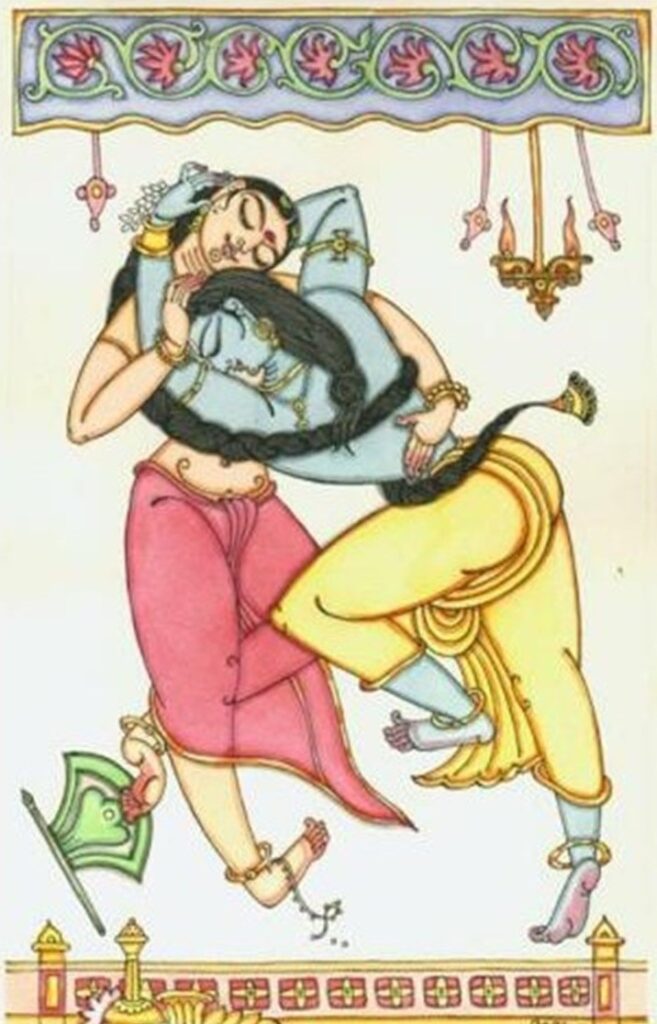
Krishna kills Kuvalayapeedam, the huge embodiment of the grown-up Ego. “I did it, I will enjoy it, I know it, everything is mine” are the four kinds of ego. Four Ivory legs reflect these four kinds of Ahamkaaram. One should have chaturvidha jnana; four kinds of Jnana are those who are sleeping on the cot. A cot is a place where humans rest and derive happiness. It relieves the physical strain. That cot of our aadidampathi is a platform of Bliss of the Super Self.
When Gopikas refer to black eyelining of Neela and blossoming clusters of flowers in her plait, they intend a comparison between them and Neela. While Gopikas abstain from eye linings and flowers for Vrata, Neela is enjoying them and binding Krishna with her flowers and looks. The eye is a symbol of Jnana, but the black eye-lining reflects love- Jnana Anjanaa Rekha.
Father and mother should always be together to help children and shower affection. Together, Seetha-Rama, Lakshmi-Naryana, and Neela-Krishna protect the Jeevis. If one desires Rama alone, it could be Shoorpanakha, and someone wants only Seetha, he might become Ravana and perish. In Guruparampara, the Gopikas are invoking ‘Om Sridharayanamah‘ in this poem, Goda’s pashuram.
Tiruppāvai Pāśuram 19 the Supreme Meaning
Śaraṇāgati-tattva pāśuram and the unity of Śrī and Nārāyaṇa
This pāśuram is regarded by Śrī Vaiṣṇava Ācāryas as one of the most profound and meaning-laden verses in the Tiruppāvai. Although it appears outwardly as a scene filled with śṛṅgāra rasa (conjugal and aesthetic emotion), inwardly, Āṇḍāḷ (Gōdādevī) reveals in an extraordinary manner the inseparable unity of Śrī and Nārāyaṇa, the true nature of prapatti (complete surrender), and the mystery of the experience of liberation (mokṣānubhava). Śrī Bhāṣya Appalācārya Svāmi has firmly identified this pāśuram as a Śaraṇāgati-tattva pāśuram, one that expounds the doctrine of surrender.
Nīḷādevī and Śrī Kṛṣṇa
Under the leadership of Gōdādevī, the gōpikas awaken the cowherd maidens through ten successive pāśurams and finally arrive at the magnificent mansion that is the residence of Nīḷādevī and Śrī Kṛṣṇa. Inside that mansion, clustered lamps blaze brightly, while outside, the gōpikas stand in darkness. This striking contrast between inner illumination and outer obscurity forms the background of this pāśuram.
What the gōpikas seek here is not a mere physical vision of the Lord; rather, they seek equality in divine experience (bhagavad-anubhava-sāmya). Their longing is that the privilege of service (sevā-bhāgya) granted to Nīḷādevī should also be bestowed upon them.
Common Meaning (Padārthārtha)
- Kuttuviḷakkeriya – Lamps burning in clusters
- Koṭṭukkāl kaṭṭin mēl – Upon a couch made with legs fashioned from elephant tusks
- Pañcaśayanattin mēl – Upon a bed possessing five qualities
- Pūṅkuḻal – Hair adorned with garlands of flowers
- Nappinnai – Nīḷādevī (the embodiment of Śrī-tattva)
- Malar mār pā – Śrī Kṛṣṇa, who possesses a blossoming, expansive chest
- Mai taḍam kaṇṇināy – O one with wide eyes shining with the collyrium of love
Thematic Meaning (Bhāvārtha)
Śrī Kṛṣṇa, after slaying the elephant Kuvalayāpīḍa, is resting upon a couch made from its tusks. Upon that very couch, Nīḷādevī reclines, resting upon His chest. Outside, the gōpikas plead, saying, “Will you not awaken Him even for a moment and allow Him to speak a word with us?”
Nīḷādevī hesitates, not wishing to disturb her husband’s rest. The gōpikas, however, gently question her, saying, “This is not your nature; this is not your true quality.”
Aesthetic and Emotional Nuances within the Thematic Meaning
In this dialogue, the following shine forth clearly:
- In the words of the gōpikas – the pain of separation (viraha-vedanā)
- In the conduct of Nīḷādevī – the defining mark of a surrendered soul (prapanna-lakṣaṇa)
- In the repose of Śrī Kṛṣṇa – the state of supreme bliss (paramānanda-sthiti)
Though the language employed is rich with śṛṅgāra, the ultimate aim is the revelation of Bhagavat-tattva, not sensual delight.

Law professor and eminent columnist
Madabhushi Sridhar Acharyulu, author of 63 books (in Telugu and English), Formerly Central Information Commissioner, Professor of NALSAR University, Bennett University (near Delhi), presently Professor and Advisor, Mahindra University, Hyderabad. Studied in Masoom Ali High School, AVV Junior College, CKM College, and Kakatiya University in Warangal. Madabhushi did LL.M., MCJ., and the highest law degree, LL.D. He won 4 Gold Medals at Kakatiya University and Osmania University.




Very nice description…👏
🙏🌹ఆండాళ్ దివ్య తిరువడిగళే శరణం🌹🙏